Outdoor · Fire
Fire, Placed Correctly
An outdoor fire extends the usable year by two months. Put it in the wrong place and it extends it by nothing at all.

Fire is the most effective climate device available to an outdoor room, and the most badly sited. It gets placed where it looks good from the house, in the middle of an open terrace, where the wind takes the heat and the smoke finds every seat in turn.
Radiant heat is directional and short
An open fire warms by radiation, not by heating the air. That means the heat travels in straight lines, is blocked by anything solid, and falls off with the square of the distance. Sitting 2 metres from a fire bowl you feel it clearly. At 4 metres, in a breeze, you feel almost nothing.
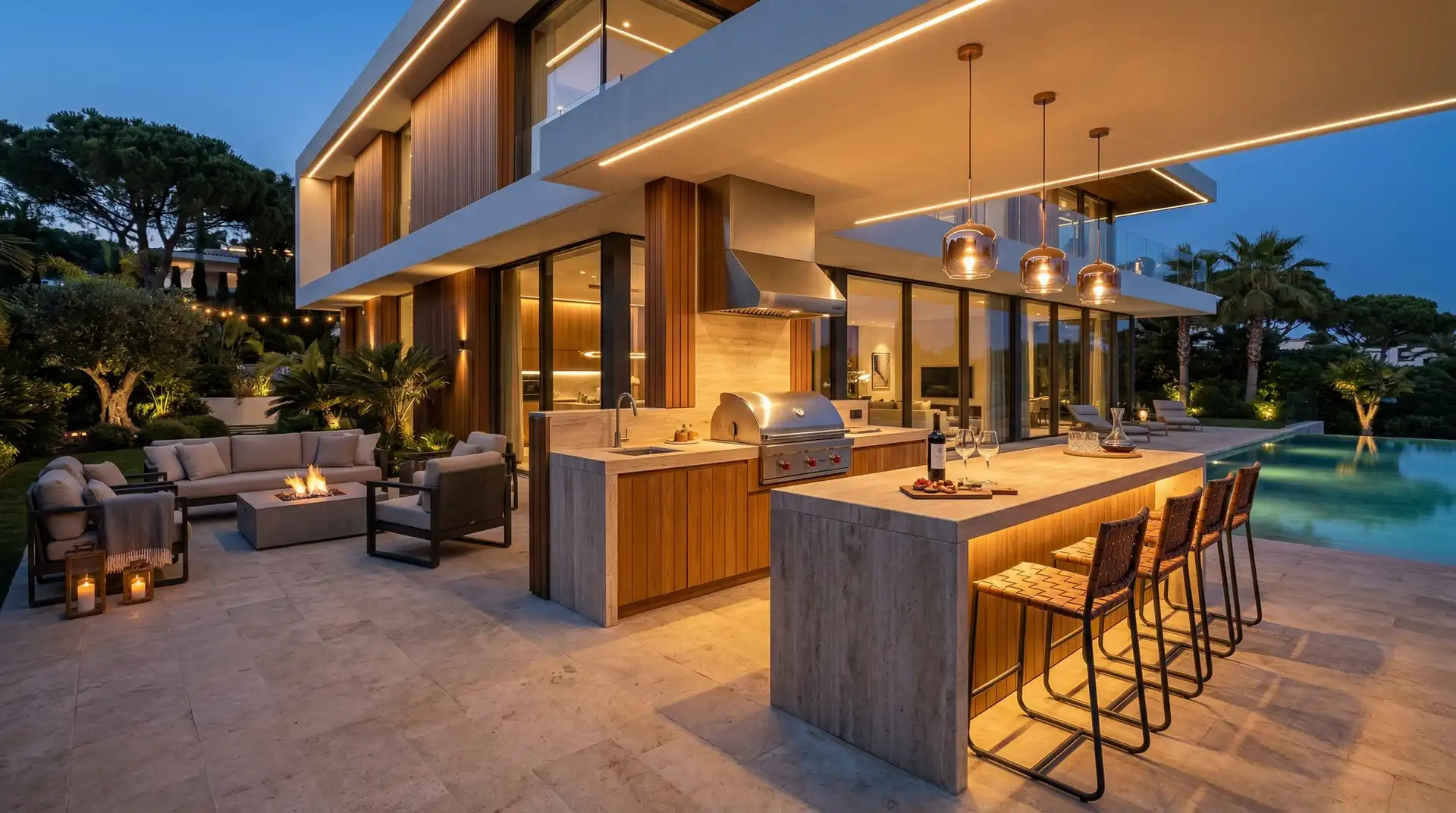
Which produces the rule that governs every good fire terrace: seating within 2 to 2.5 metres, arranged around no more than 270 degrees of the fire, with something solid behind the seats to reflect heat back and stop the draught.
Wind, again
Place the fire on the windward side of the seating and you have built a smoke machine. Place it in the lee of a wall and it burns steadily, the heat stays, and people can sit downwind without weeping.
If the terrace has no shelter, build some: a low wall, a planted bed, a raised bank. A fire pit sunk 50 centimetres below the surrounding level, with seating on the rim, is both a wind strategy and a social one, because it puts everyone at the same height facing each other.
A fire that people sit around is a room. A fire that people look at is a lamp.
Kirsten Aalto, landscape designer, Helsinki
The masonry version
The most underrated outdoor element in Mediterranean building is the fixed hearth: a stone or rendered mass built into a terrace wall, with a shallow firebox, a hood and a hob shelf beside it.
It costs more than a bowl and returns more: the mass stores heat and radiates for hours after the fire dies, the wall shelters the flame, and the shelf gives you somewhere to cook, which turns the fire from an object into equipment.
Distances that keep you legal and unburnt
Two metres of clear space above an open fire before any structure, and three if that structure is timber or fabric. Pergola over a fire pit is the single most common serious mistake on terraces, and the one that produces the calls to insurers.
One metre of non-combustible surface around the fire in every direction. Not gravel with dry planting behind it: sparks travel, and August grass is fuel.
Fuel storage, which is half the decision
A wood fire needs a place for wood, and the place has to be dry, ventilated, close enough to be used and out of the weather. Two cubic metres, the realistic quantity for a season of evening fires, is a stack around 1.5 metres long, 1 metre high and 1.2 metres deep.
Designed in, it becomes a wall: a recess in the terrace masonry, a store under a bench, a slot beside the hearth. Left out, it becomes a plastic sheet over a heap by the side of the house, and after two seasons the fire stops being used because fetching the wood is a nuisance.
Wood also needs to be dry. Freshly cut timber can hold half its weight in water, burns badly, smokes heavily and coats the flue in tar. Buy seasoned, or buy a year ahead and store it properly, which is the same amount of money and a much better fire.
What to build it out of
Firebricks for the box, because ordinary brick and concrete spall when they are repeatedly heated and cooled. A stainless or cast liner where there is a flue. Stone or rendered blockwork outside that, which is what you actually see.
The two failures that recur are a hearth built entirely of local stone that cracks in its second winter, and a fire pit lined with nothing at all, where the concrete is quietly turning to dust from the inside. Neither is expensive to avoid, and neither can be repaired without taking the thing apart.
The two-month return
In a temperate coastal climate, a well-placed fire adds roughly four weeks at each end of the outdoor season. That is eight weeks of evenings, every year, for the price of a good sofa.
Nothing else on a terrace, no heater, no glass screen, no infrared panel, delivers that. It just has to be in the right place, which is out of the wind, close to the seats, with a wall at your back.