Outdoor · Planting
The Mediterranean Garden Without a Lawn
The lawn is a northern European habit exported to places that cannot support it. What replaces it is more interesting and needs a tenth of the water.

A lawn in a dry climate is an agricultural crop with no yield. It requires between 600 and 1000 litres per square metre per year, it is at its worst in the months you are outdoors, and it produces the one thing a garden does not need in August: a flat green surface that is too hot to sit on by eleven in the morning.
The alternative is not gravel and three cacti. It is the planting that grew there before irrigation arrived.
The structure that replaces grass
Take away the lawn and something must hold the composition together. Three elements do it.
Ground. Compacted stone fines, decomposed granite or fine gravel, in a colour taken from local rock rather than from a catalogue. It drains, it stays cooler than paving, and it makes a sound underfoot that people notice and cannot name.
Mass. Clipped evergreen shapes that hold form all year: rosemary, myrtle, teucrium, westringia, phillyrea. These are the furniture of a dry garden, the volumes that give it structure in February when nothing is flowering.
Canopy. One tree per outdoor room. Olive, carob, judas tree, strawberry tree, almond. Not a specimen to admire from a window but a canopy to sit under, which means it must be positioned by where the shade falls at four in the afternoon, not by where it balances the elevation.
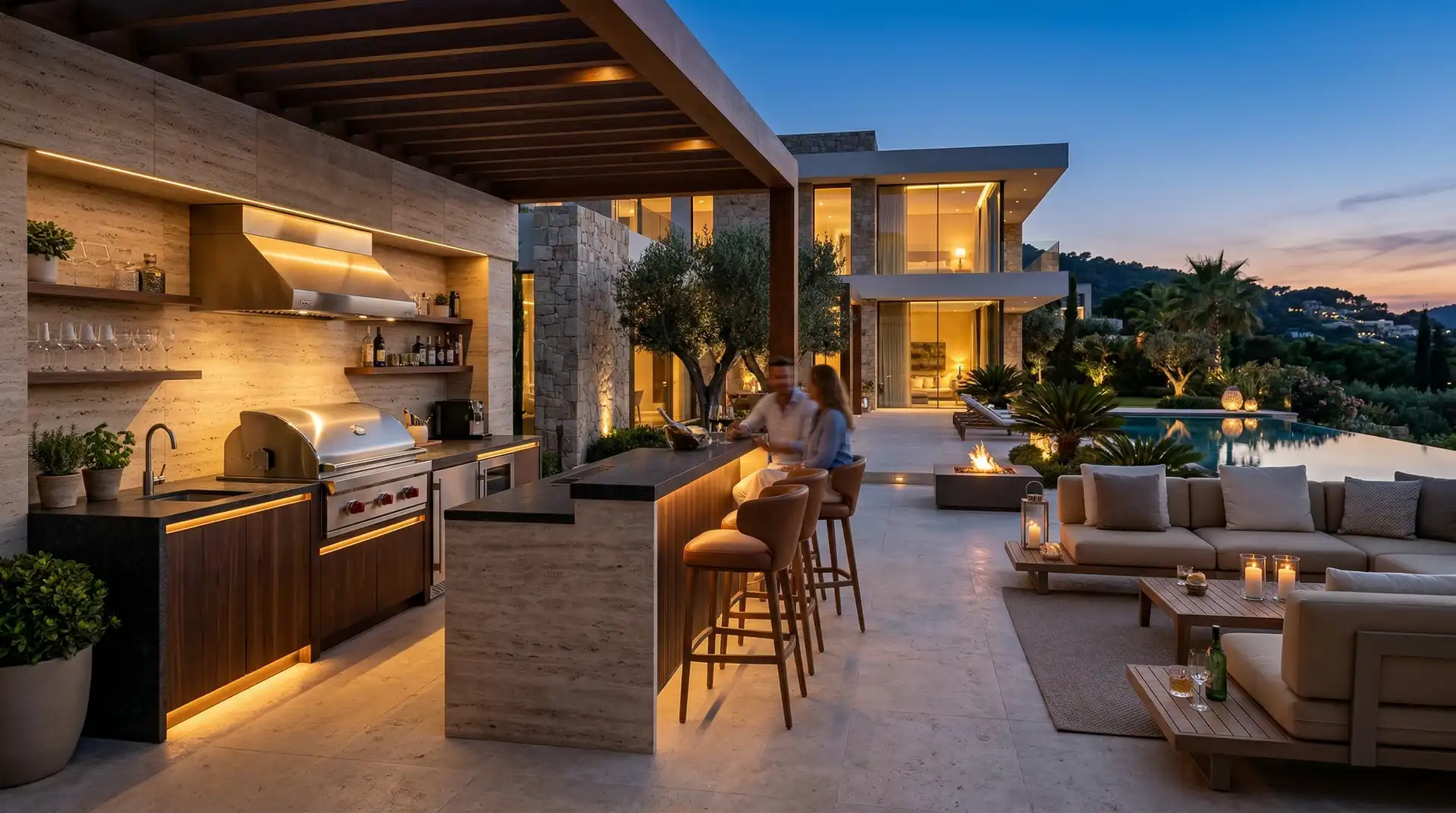
Plant the shade first. Everything else in a hot garden is arranged in relation to where you can stand at four o'clock.
Nuria Sender, garden designer, Mallorca
Water, and the first two years
Drought tolerant does not mean drought tolerant on arrival. Almost every Mediterranean plant needs deep, infrequent watering for two full summers to establish a root system that will then never need you again.
Deep and infrequent is the entire technique: 20 litres to a shrub once a fortnight beats 3 litres every other day, which produces shallow roots and dependency. Drip lines on a timer, on the surface under mulch, removable after two years.
Mulch is not decoration
A 7 to 10 centimetre layer of gravel or crushed stone over planted areas reduces evaporation by roughly two thirds, keeps root zones cool, suppresses weeds and stops the surface crusting in heavy rain.
It is the single highest-return item in a dry garden and it is usually the line clients cut, because a lorry of stone is unglamorous compared with more plants. The correct trade is fewer plants, properly mulched.
The first year is the whole project
A dry garden looks sparse when it is planted and complete in its third summer. That gap is where most of them are ruined, by owners who fill the spaces with more plants, and by gardeners who water everything twice a week to make it look established.
Plant at final spacing and accept the bare ground. Mulch it, so it reads as a considered surface rather than a gap. Water deeply, fortnightly, in the first two summers and then stop, which is the instruction that most garden maintenance contracts quietly ignore.
By year three the shrubs touch, the mulch has weathered into the planting and the whole thing looks as though it grew there. Do it the other way, packed and irrigated, and by year three you have a hedge of tangled woody shrubs with a water bill.
Maintenance, which is different rather than absent
Nobody should sell you a garden that needs nothing. A dry garden needs two things a year and both are quick.
A hard clip in late winter, before growth starts, on the evergreen structure: rosemary, lavender, teucrium, westringia. Clip into shape rather than shearing flat, and never cut back into old bare wood on lavender or rosemary, which will not regrow from it.
Then a top-up of mulch every two or three years, because gravel migrates and organic mulch breaks down. That is it. No mowing, no feeding, no weekly watering, and no bedding to replace twice a year. Two afternoons, against roughly forty for a lawn of the same area.
What you gain
Water use drops by eighty to ninety per cent. Maintenance moves from weekly mowing to two clipping sessions a year. And the garden acquires something a lawn structurally cannot have: scent in the heat, movement in wind, texture at three metres, and the sound of bees, which is the actual soundtrack of a summer garden.
The one thing you lose is a surface for children to run on. If that matters, build a small lawn, 30 or 40 square metres, in the shade where it will survive, and let the rest of the garden be what the climate wants.