Architecture · Envelope
Glass, Reconsidered
The picture window won. Now comes the reckoning: what a wall of glass costs in comfort, energy and privacy, and where it earns its place.
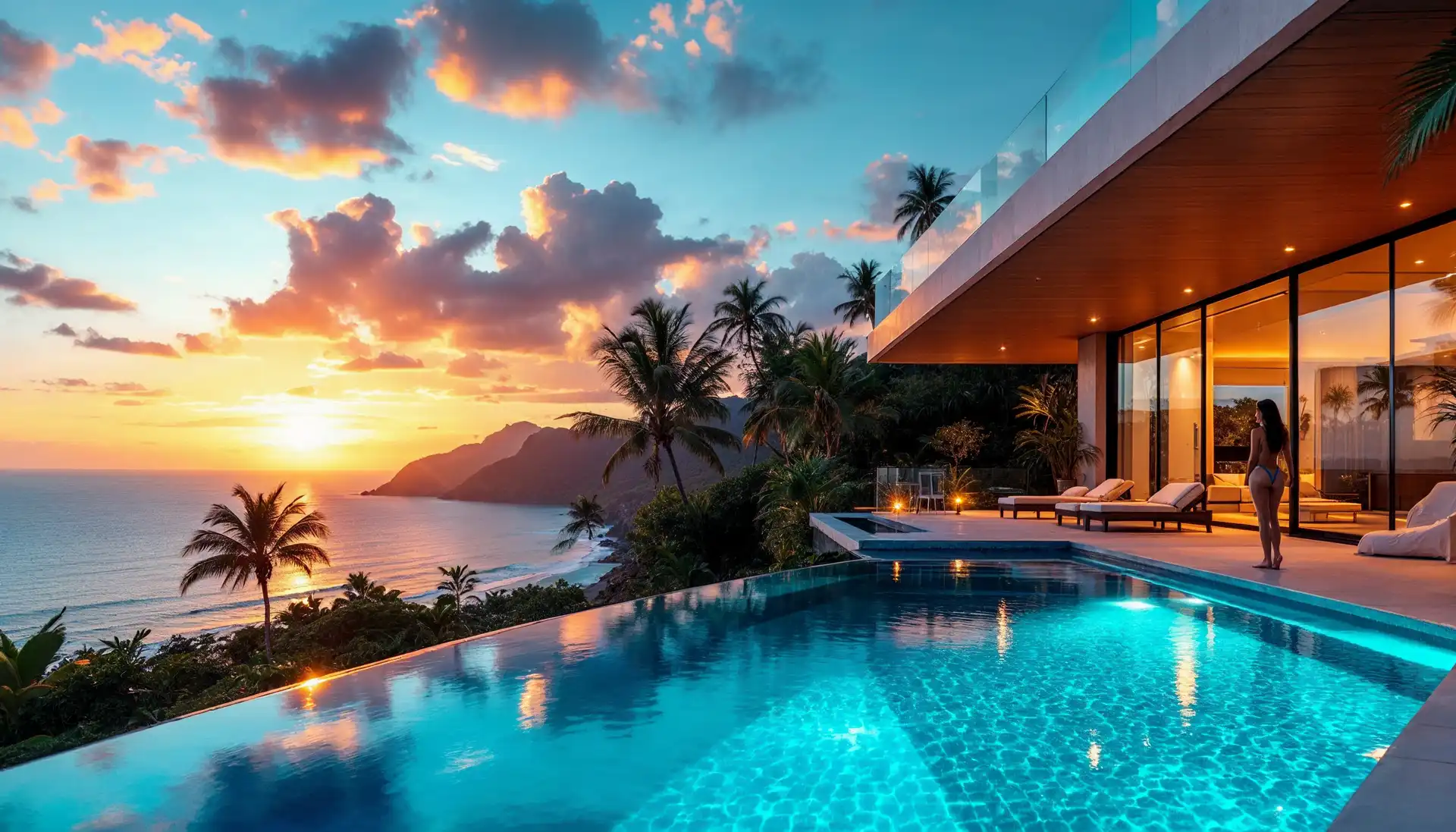

Somewhere in the last twenty years, glazing stopped being a decision and became a default. Every render shows a corner that opens. Every brochure promises that inside and outside will become one. And every second owner of a glass house learns, in their first August, that they have bought a greenhouse with a sofa in it.
The physics you cannot design around
A triple-glazed unit is roughly six times worse at holding heat than the insulated wall next to it, and about thirty times better at letting solar radiation in. Both facts are useful, and both are seasonal.
South-facing glass in winter is a gift: free heat, arriving exactly when the sun is low enough to reach deep into the room. The same glass in summer, with the sun high, is nearly neutral if you shade it and catastrophic if you do not. West-facing glass is the villain in every climate: low afternoon sun, no overhang geometry that can block it, arriving at the hottest hour of the day.
Shade is cheaper than coating
The industry sells solar control glass because it is a product. Geometry is not a product, so nobody sells it, but it works better.
A horizontal overhang sized for your latitude blocks high summer sun and admits low winter sun automatically, with no moving parts and no maintenance. On the east and west faces, where the sun is low, only vertical fins or moveable external shutters do anything at all. Internal blinds stop glare and almost no heat: by the time the radiation has passed the glass, it is already in the room.
Every square metre of unshaded west glazing buys you a room you will not use between four and eight in the evening.
Tobias Lenz, building physicist
What full-height glass does to a room
There is a psychological cost that never appears in the energy model. A room glazed to the floor on two sides has no back. Nowhere to put a bookshelf, a bed, a piano, a person who wants to sit with their spine covered. Furniture ends up floating in the middle, and the room, however spectacular, is subtly uninhabitable.
The most comfortable glass houses keep one solid wall in every room. It is the wall that makes the glass feel like a choice rather than an exposure.
The frame is the building
Nobody notices the glass. Everybody notices the frame. A 120 millimetre aluminium section between you and the sea reads as a window. A 25 millimetre steel section reads as an absence, and costs perhaps four times as much.
Between those poles sit the decisions that actually matter: whether the sliding track is recessed flush into the floor, whether the head detail hides the blind box, whether the meeting stile of a two-panel slider lands in the middle of your view. Look at the last one before you sign anything. It is the mistake that cannot be fixed later.
What it costs to keep clean
Nobody includes this in the specification, and everybody discovers it. A house with 60 square metres of glazing needs cleaning perhaps six times a year, and on anything above ground floor level or over water that means access equipment.
Two decisions reduce it to something manageable. Design every pane so it can be reached from a solid surface, a terrace, a walkway, a flat roof, without a ladder standing on gravel. And put a tap and a drain within twenty metres of the largest glazed elevation. In coastal locations, add salt to the calculation: unwashed glass within two hundred metres of the sea etches permanently within a few years.
The safety details that are not optional
Full-height glass introduces three requirements that get discovered late and fixed badly. Any pane a person can walk into needs manifestation, a visual marker at eye level, unless the frame or a transom already does that job. Any pane below 800 millimetres from the floor must be laminated or toughened. And a fixed pane acting as a barrier where there is a level change needs to be rated as a barrier, which is a different and heavier specification than a window.
None of that has to look institutional. A shadow line etched at 1500 millimetres, a slender steel mullion, a planted bed on the outside that keeps people a metre back: all of them satisfy the requirement without a sticker.
Where glass earns its keep
Not in a wall. In an aperture: a single, generous, well-proportioned opening that frames one thing, placed where you stand rather than where the elevation looked balanced on a screen.
The rooms people remember are almost never the ones with the most glass. They are the ones where the window is exactly the right size, in exactly the right place, and the rest of the room is quiet enough to let you notice.