Outdoor · Shade
Shade Is a Material
In a hot climate, shade is not a comfort feature. It is the structure that decides which parts of your plot exist between May and September.

Draw a plan of a warm-climate house and shade the areas that are usable at three in the afternoon in July. Usually less than a quarter of the outdoor space survives, and it is rarely the quarter with the furniture in it.
Shade is not an accessory to that plan. It is the plan.
The four kinds, in order of quality
Building shade. A deep overhang, a recessed loggia, a projecting upper floor. Permanent, maintenance free, structurally integrated and by far the best. It also has the greatest effect on the building's own cooling load, because it stops the sun before it reaches the glass.
Vegetal shade. A tree, a vine on a frame, a canopy of pergola planting. Cools by transpiration as well as by blocking sun, which makes it measurably cooler underneath than a solid roof, by two to four degrees. Deciduous species give shade in summer and let winter sun through, which no manufactured system does.
Fixed screening. Slats, brise soleil, reed, timber grids. Orientation dependent: horizontal for south, vertical for east and west. Cheap, effective, and dependent on being drawn to the right angle rather than the right look.
Fabric. Sails, awnings, umbrellas. Fast, flexible, seasonal and the first thing to fail. Useful as a supplement, unreliable as a strategy: in wind, everything retractable is retracted.
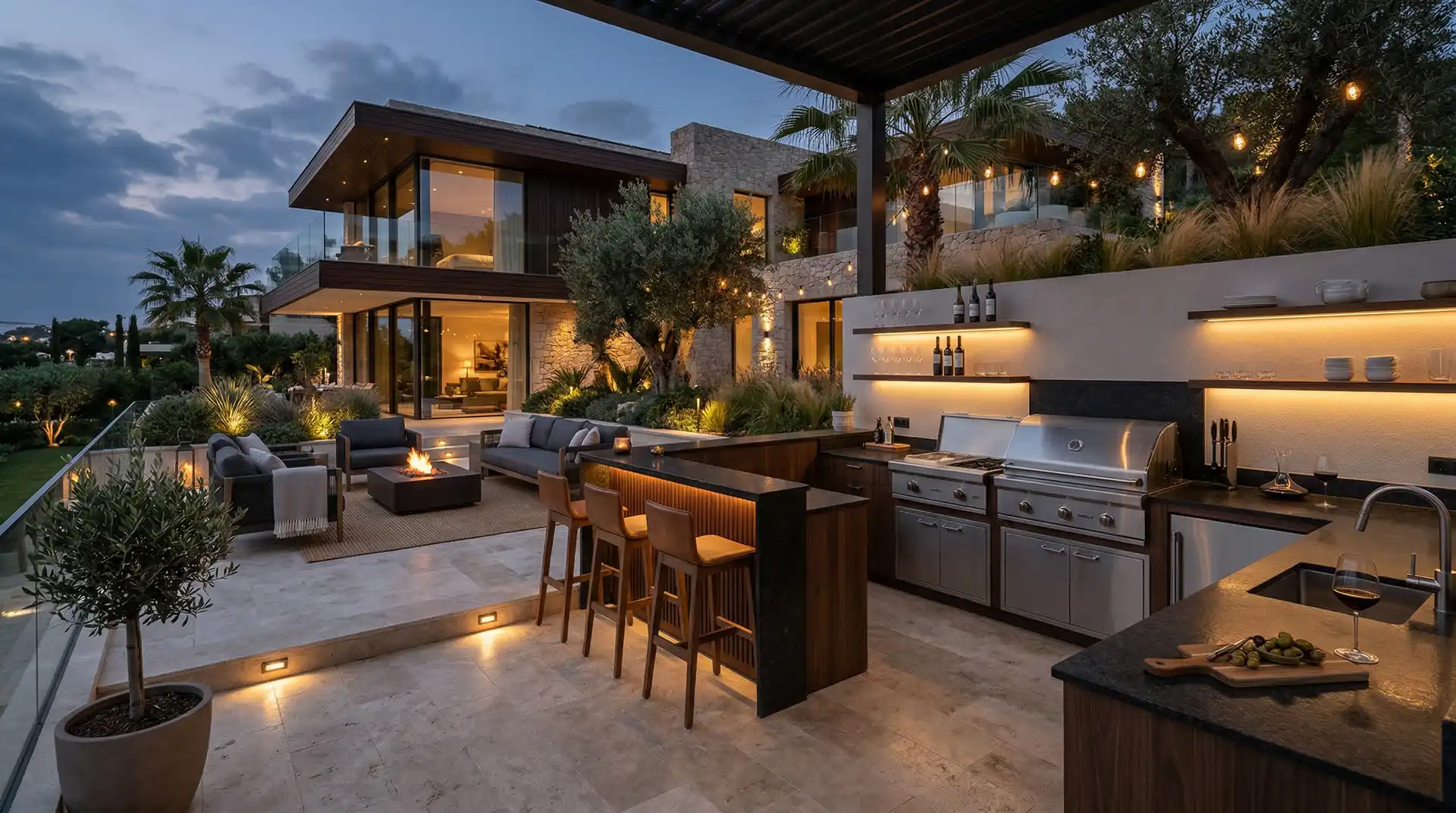
A pergola with nothing growing on it is a sundial. It tells you the time by moving stripes across your lunch.
Léa Marchetti, architect, Nice
The slatted pergola problem
Slats at 50 per cent coverage give 50 per cent shade at exactly one moment of the day and a moving pattern of stripes the rest of the time. Sitting under them at lunch, half of you is in 35 degree sun.
If you want to sit under a pergola in August, it needs a solid or near-solid covering over the seating zone: a vine grown thick, a reed mat, a fabric panel above the slats, or a solid section over the table with slats beyond. Two thirds coverage minimum. Anyone who tells you 30 by 30 millimetre battens at 50 millimetre centres will shade a lunch table has not eaten under one.
The thermal difference, measured
Under a solid roof in full summer, air temperature drops roughly 2 to 3 degrees compared with open sun, and radiant temperature, which is what your skin feels, drops far more.
Under a dense vine, air temperature drops 4 to 6 degrees, because the leaves are actively evaporating water. That is the difference between sitting outside at two in the afternoon and going indoors, and it is available for the price of a plant and a proper frame.
What the ground does to the heat
Shade over your head only solves half the problem. In full sun a dark stone or porcelain terrace reaches 55 to 65 degrees and radiates that heat upwards for hours after sunset, which is why a shaded chair on a hot paving can still feel like sitting in front of a heater.
Pale limestone, travertine and light concrete typically stay 15 to 20 degrees cooler under the same sun. Timber decking sits in between and stays comfortable underfoot longer because it conducts poorly. Gravel is coolest of all and least comfortable for furniture.
If a terrace has to be dark for design reasons, shade the ground itself rather than only the seats, and expect to water it down on the hottest evenings, which is what people in hot countries have always done.
Shade changes with the season, and so should you
The best shading strategies are seasonal rather than fixed, because the sun is 25 degrees higher in June than in December and a device sized for one is wrong for the other.
Deciduous planting does this automatically: leaves in July, bare branches in January. A vine on a pergola is the classic version and works better than any engineered system. Retractable fabric does it manually, if somebody actually retracts it. Fixed slats do not do it at all, which is why a slatted pergola that is pleasant in August makes the room behind it dark in December.
If you can only build one thing, build the frame and plant the vine. It costs less than the fabric system, performs better, and improves every year rather than fading.
The plot as a map of shade
The exercise worth doing before any furniture is bought: mark on the plan where shade falls at 10:00, 14:00 and 18:00 in July, then again in October.
Breakfast goes in the morning sun. Lunch goes in the July shade. Evening drinks go where the October sun still reaches at six. Almost nobody does this, and it is why so many gardens have one perfect spot that everyone crowds into and three empty terraces facing the wrong way.